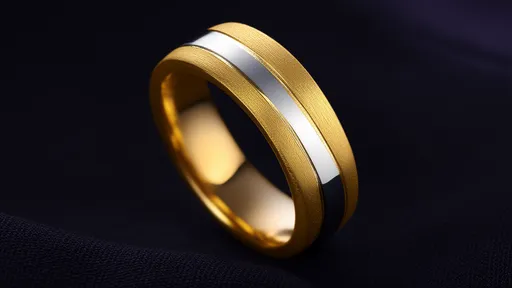
The jewelry industry is undergoing a quiet revolution in surface finishing techniques, particularly in gold ornamentation. As we approach 2025, the interplay between matte and glossy surfaces has evolved beyond mere aesthetic choices into a sophisticated design language. This year's most compelling gold pieces demonstrate how craftsmen have elevated the humble contrast between sandblasted and mirror-polished finishes into something approaching high art.
Walking through the halls of Baselworld 2024, one couldn't help but notice how the traditional boundaries between these finishes have blurred. What began as simple geometric demarcations - a sandblasted border framing a polished center - has matured into organic, flowing transitions that resemble topographical maps. Swiss ateliers in particular have pioneered a technique they call "brume d'or" (gold mist), where the shift from matte to reflective happens gradually across millimeters, creating an almost holographic effect when the piece catches light at different angles.
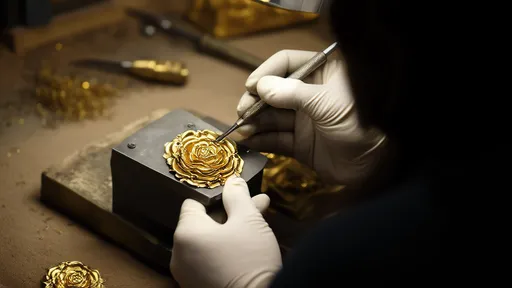
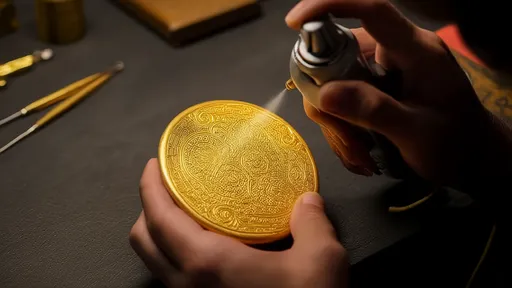
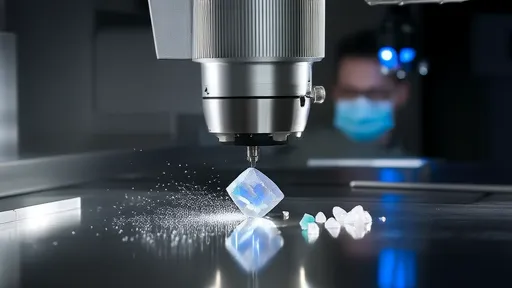
The physics behind these new finishing techniques reveals why 2025 marks a watershed moment. Traditional sandblasting used uniform aluminum oxide particles to create consistent matte surfaces. Now, jewelers employ graduated particle sizes - from 50 to 500 microns - within single design elements. This creates subtle variations in light diffusion that make gold appear to change texture as the wearer moves. When juxtaposed against new high-definition mirror polishing methods (using diamond suspensions down to 0.1 micron), the visual impact becomes three-dimensional.
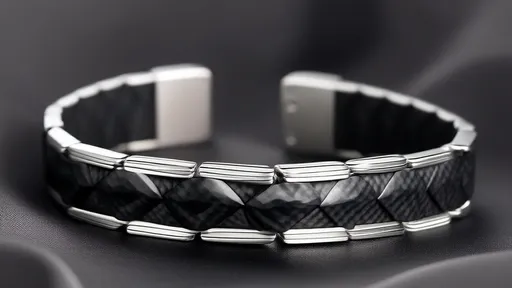
Italian workshops have taken a different approach, developing what they term "pixelated finishes." By combining laser etching with microscopic sandblasting, they create surfaces where matte and glossy areas alternate in patterns invisible to the naked eye but which produce extraordinary optical effects. A bracelet might appear uniformly satin until it moves, suddenly revealing hidden constellations of light that seem to float beneath the surface. This represents a complete inversion of traditional jewelry design principles - where once we decorated surfaces, now we engineer how light interacts with them at a structural level.
Material science breakthroughs have enabled these artistic innovations. The development of more durable gold alloys (particularly 22k gold with ruthenium additives) allows for sharper definition between finishes without edge wear. Japanese metallurgists have created a proprietary 24k gold variation that maintains mirror polish for 73% longer than conventional formulas, while still accepting sandblasted textures that remain stable over decades. These advancements solve what was previously the Achilles' heel of mixed-finish jewelry - the tendency for polished areas to dull and matte areas to polish unevenly with wear.
The cultural significance of these technical achievements shouldn't be underestimated. In Middle Eastern markets, where high-carat gold has always dominated, the new finishes allow traditional designs to appeal to younger consumers without sacrificing cultural authenticity. A classic mesh bracelet gains contemporary relevance when its links alternate between sandblasted Arabic calligraphy and mirror-polished backgrounds. Meanwhile, Western designers are using the techniques to reinvent Art Deco motifs, with geometric patterns that seem to shift between positive and negative space depending on viewing angle.
Perhaps most surprisingly, these surface treatments are changing how we perceive gold's intrinsic value. Where once weight and purity were the sole determinants of worth, connoisseurs now appraise pieces based on finish complexity. A 40-gram bracelet featuring seven graduated texture zones may command higher prices than a simpler 60-gram piece. This represents a fundamental shift in valuation paradigms that will undoubtedly influence both manufacturing and retail strategies moving forward.
As we look toward the rest of 2025 and beyond, the next frontier appears to be "kinetic finishes" - surfaces that change their texture properties in response to temperature or touch. Prototypes shown at private viewings in Paris suggest that gold jewelry may soon have the ability to transform from entirely matte to fully reflective at the wearer's discretion. While these technologies remain in development, they promise to erase entirely the line between jewelry and wearable technology, all while maintaining the timeless allure of gold that has captivated humanity for millennia.
The evolution of sandblasted and mirror-polished finishes represents more than just technical progress - it's a philosophical realignment of how we interact with precious metals. Gold remains constant in its chemical composition, but our ability to converse with light through its surface has entered an entirely new dimension. As these techniques trickle down from haute joaillerie to more accessible pieces, we're witnessing the democratization of what was once the exclusive domain of master craftsmen. The golden age of gold finishes, it seems, is just beginning.
By /Aug 27, 2025
By /Aug 19, 2025
By /Aug 19, 2025
By /Aug 27, 2025
By /Aug 19, 2025
By /Aug 19, 2025
By /Aug 19, 2025
By /Aug 19, 2025
By /Aug 19, 2025
By /Aug 19, 2025
By /Aug 19, 2025
By /Aug 19, 2025

By /Aug 27, 2025
By /Aug 19, 2025
By /Aug 27, 2025
By /Aug 27, 2025
By /Aug 19, 2025

By /Aug 19, 2025

By /Aug 27, 2025

By /Aug 19, 2025
