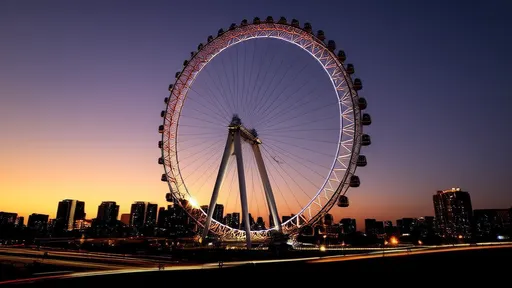
In the heart of every bustling amusement park, the Ferris wheel stands as an iconic testament to both engineering prowess and geometric elegance. Its circular trajectory, often perceived as a simple loop, conceals a world of mathematical beauty and physical harmony. The so-called "Perfect Encounter Law" of circular motion in Ferris wheels is not merely a whimsical concept but a profound intersection of geometry, physics, and human experience. This principle governs the synchronized movement of gondolas, the timing of passenger interactions, and the very rhythm of the wheel's rotation, creating moments of fleeting connection against the backdrop of a perfect circle.
The geometry of the Ferris wheel is deceptively straightforward: a large wheel rotating around a central axis, with passenger cabins attached equidistantly along its rim. Yet, within this simplicity lies a complex dance of angles, arcs, and relative motions. Each gondola follows a circular path with uniform speed, but its position relative to the ground and to other gondolas is in constant flux. The Perfect Encounter Law emerges from this dynamic, describing how and when these cabins align, oppose, or cross paths in ways that seem almost predestined. It is a phenomenon that captivates mathematicians and romantics alike, for it turns a mechanical ride into a ballet of calculated coincidences.
At the core of this law is the interplay between rotational symmetry and periodic motion. As the wheel turns, the gondolas traverse identical circular paths but at staggered phases. Their positions can be modeled using trigonometric functions, with time as the variable. The encounters—whether between two gondolas reaching the same height simultaneously or passing each other at precise points—are dictated by the phase differences and the wheel's angular velocity. For instance, if two cabins start diametrically opposite, they will meet at the top and bottom of the wheel at regular intervals, a consequence of their 180-degree phase shift. This predictability is what forms the "law" in its truest sense: a reliable, mathematical certainty amidst the apparent chaos of motion.
Beyond the abstract beauty of equations, the Perfect Encounter Law has tangible implications for design and safety. Engineers leverage this geometric principle to ensure balanced load distribution, minimizing stress on the structure. By spacing gondolas at equal angular intervals, they maintain rotational equilibrium, which is crucial for the smooth operation of the wheel. Moreover, the timing of these encounters influences boarding and disembarking protocols, as operators can anticipate when cabins will be at optimal positions for passenger exchange. Thus, what begins as a geometric curiosity becomes a foundational element of functional design.
The allure of the Ferris wheel, however, transcends mathematics and mechanics. It taps into something deeply human: the desire for connection and the poetry of chance meetings. The Perfect Encounter Law gives form to these ephemeral moments—a smile exchanged with a stranger in a passing cabin, the synchronized wave between riders at identical heights, or the shared awe of a panoramic view from the apex. In these instances, the rigid rules of geometry yield to the fluidity of human emotion, transforming the wheel into a stage for serendipity. It is no wonder that Ferris wheels often feature in stories and films as symbols of fate and romance; their motion literally orchestrates encounters that feel both inevitable and magical.
Interestingly, the principle is not exclusive to Ferris wheels. It echoes in other circular systems, from planetary orbits to gear mechanisms, underscoring a universal harmony in rotational motion. Yet, the Ferris wheel remains uniquely accessible, a microcosm of this cosmic order that people can experience firsthand. As riders ascend and descend, they participate in a timeless dance governed by angles and arcs, each revolution a reaffirmation of the perfect encounters that geometry alone can decree.
In conclusion, the Perfect Encounter Law of Ferris wheel geometry is a fascinating blend of science and sentiment. It demonstrates how mathematical principles can shape not only physical structures but also human experiences, creating moments of precision and poetry alike. The next time you board a Ferris wheel, remember that your journey is part of a larger, beautifully orchestrated pattern—one where every meeting, however brief, is a perfect intersection of motion and meaning.

By /Aug 27, 2025

By /Aug 19, 2025

By /Aug 19, 2025
By /Aug 27, 2025

By /Aug 19, 2025

By /Aug 19, 2025
By /Aug 19, 2025
By /Aug 19, 2025

By /Aug 19, 2025

By /Aug 19, 2025

By /Aug 19, 2025

By /Aug 19, 2025
By /Aug 27, 2025

By /Aug 19, 2025
By /Aug 27, 2025

By /Aug 27, 2025

By /Aug 19, 2025
By /Aug 19, 2025
By /Aug 27, 2025
By /Aug 19, 2025
