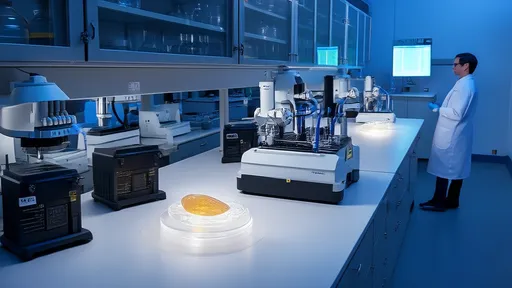
The field of amber identification has taken a significant leap forward with the expansion of the Fourier-transform infrared spectroscopy (FTIR) reference library to encompass 5,000 unique spectra. This milestone represents years of meticulous data collection, cross-verification, and collaboration between gemological laboratories, research institutions, and field experts. The enhanced spectral database now covers an unprecedented range of geographical sources, age variations, and treatment types, fundamentally altering how professionals authenticate and study this organic gemstone.
For decades, FTIR spectroscopy has served as the gold standard for distinguishing natural amber from copal, synthetic resins, and modern polymer imitations. However, limitations in reference data often forced gemologists to rely on subjective interpretations when encountering borderline cases or newly discovered deposits. The newly expanded library addresses this gap by incorporating rare specimens from previously underrepresented regions like the Amazon Basin, East African copals, and Baltic amber subtypes with distinct maturation levels. This granularity enables analysts to pinpoint not just authenticity but often the approximate geological age and provenance of samples—a capability once considered impossible for most commercial testing scenarios.
Behind this achievement lies a multi-phase project initiated in 2018 by the International Amber Association (IAA) in partnership with the Gemological Research Collective. Researchers employed strict protocols: each spectrum underwent validation through complementary techniques like Raman spectroscopy and gas chromatography-mass spectrometry (GC-MS). Particular attention was given to documenting treated ambers—a growing concern as heat-treated and polymer-stabilized variants flood markets. The library now includes 47 distinct categories of enhancement signatures, from traditional "sun spangled" thermal effects to modern surface-diffusion treatments that mimic rare blue amber.
Field applications have already demonstrated the library's transformative impact. At the recent Baltic Amber Symposium, Dr. Elina Vaskelainen presented case studies where the expanded database identified Burmese amber inclusions previously misclassified as Colombian. Such distinctions carry ethical weight, as Burmese amber faces trade restrictions due to political conflicts, while Colombian copal remains widely traded. Auction houses like Sotheby's have begun requiring updated FTIR reports for high-value amber lots, reflecting heightened industry confidence in the methodology.
Challenges persist, however. The organic nature of amber means spectra can vary even within a single specimen due to oxidation layers or included organic matter. To address this, the library incorporates "range spectra" showing acceptable variances for key absorption bands. Conservationists have raised concerns that detailed provenance data could inadvertently facilitate looting of amber-rich archaeological sites. In response, the IAA has implemented tiered access—with full spectra available only to certified laboratories while maintaining a simplified version for law enforcement and customs agencies.
Looking ahead, researchers are already planning Phase II of the project: integrating machine learning algorithms to handle complex spectra mixtures. When completed in 2026, this could enable automatic detection of composite ambers (where fragments are fused with modern resins) and even predict optimal conservation conditions based on an artifact's spectral fingerprint. As the amber trade navigates increasing scrutiny over ethical sourcing and accurate disclosure, this robust analytical framework sets a new standard for transparency in organic gemology.
The implications extend beyond commerce into paleontology and climate science. The spectral database includes 137 amber specimens with precisely dated insect inclusions, creating a chronological framework for studying ancient ecosystems. Climate researchers have utilized the library to track historical resin composition changes, revealing how prehistoric warming events affected tree resin chemistry—an innovative proxy for understanding modern climate change impacts. This interdisciplinary utility underscores why the FTIR expansion represents more than technical progress; it's a bridge between gemology and fundamental scientific inquiry.
For collectors and appraisers, the practical benefits are immediate. The ability to differentiate between, say, Dominican blue amber and heat-treated lookalikes protects buyers from sophisticated frauds. Museums now routinely cross-reference new acquisitions against the library, as seen in the Metropolitan Museum of Art's recent verification of a 17th-century amber cabinet previously attributed to Königsberg workshops. As database curator Dr. Henrik Weber notes, "We're not just identifying amber anymore—we're reading its biography." With each spectrum serving as a chemical timestamp, this expanded FTIR library transforms amber from a beautiful curiosity into a documented chronicle of Earth's history.
By /Aug 27, 2025
By /Aug 19, 2025
By /Aug 19, 2025
By /Aug 27, 2025
By /Aug 19, 2025
By /Aug 19, 2025
By /Aug 19, 2025
By /Aug 19, 2025
By /Aug 19, 2025
By /Aug 19, 2025
By /Aug 19, 2025
By /Aug 19, 2025
By /Aug 27, 2025
By /Aug 19, 2025
By /Aug 27, 2025
By /Aug 27, 2025

By /Aug 19, 2025
By /Aug 19, 2025
By /Aug 27, 2025
By /Aug 19, 2025
