In the intricate dance of nature's architecture, few patterns captivate the scientific and artistic imagination quite like the logarithmic spiral. This elegant curve, often associated with the golden ratio, appears in phenomena ranging from galaxies to hurricanes, and now, remarkably, in the humble shells of mollusks. Recent research has unveiled a fascinating connection between the formation of these shells and the deposition of calcium carbonate, governed by the mathematical precision of the logarithmic spiral and the divine proportion of phi.
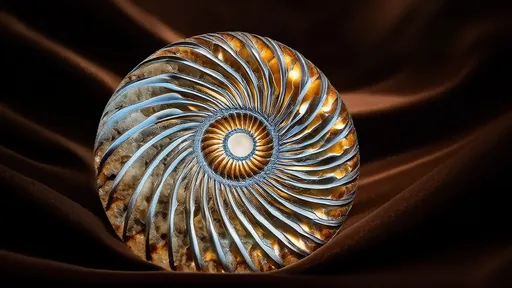
The story begins with the mollusk itself, a soft-bodied organism that secretes calcium carbonate to construct its protective home. For centuries, the exquisite spirals of shells like those of the nautilus have been admired, but only recently have scientists begun to decipher the biochemical and physical mechanisms that produce such perfection. It turns out that the process is not merely a random accumulation of material but a highly regulated, rhythmic deposition influenced by the organism's genetics and environmental factors.
At the heart of this process lies the logarithmic spiral, a shape defined by its property of maintaining the same angle with respect to its center at every point. This self-similar growth pattern allows the shell to expand without changing shape, a feat of natural engineering that maximizes strength and efficiency. The golden ratio, approximately 1.618, often emerges in the proportions of these spirals, contributing to their aesthetic harmony and functional superiority. Researchers have found that the mollusk's mantle tissue secretes calcium carbonate in discrete increments, each deposition following the mathematical blueprint of the spiral.
The deposition of calcium carbonate is a complex biochemical symphony. Specialized cells in the mantle control the ionic composition of the extrapallial fluid, from which calcium carbonate precipitates. Proteins and organic matrices act as templates, guiding the crystallization into either calcite or aragonite, the two common forms of calcium carbonate in shells. What is astounding is how this biological machinery is orchestrated to adhere to the logarithmic spiral. Studies suggest that the rate of secretion and the timing of deposition are tuned to produce the constant growth angle characteristic of the spiral.
One prevailing hypothesis is that the golden ratio arises from the optimization of resource allocation. The spiral allows for efficient use of energy and materials, providing maximum protection with minimal investment. In mathematical terms, the growth proceeds such that each new chamber or layer is a scaled version of the previous one, multiplied by the golden ratio. This not only creates a visually pleasing form but also ensures structural integrity, as the spiral distributes stress evenly throughout the shell.
Advanced imaging techniques, such as scanning electron microscopy and micro-CT scanning, have allowed scientists to observe this process in unprecedented detail. They have visualized the incremental growth bands, each corresponding to a pulse of deposition, and mapped them onto the logarithmic curve. Computational models have been developed to simulate the growth, incorporating factors like nutrient availability, temperature, and genetic instructions. These models consistently reproduce the golden spiral, suggesting that it is an emergent property of the system's dynamics.
Beyond its biological significance, this discovery has profound implications for materials science and biomimetics. Engineers and architects are looking to mimic this natural process to create stronger, lighter, and more sustainable materials. By understanding how mollusks achieve such precision without advanced tools, we can develop new methods for fabricating ceramics and composites. The logarithmic spiral, with its blend of beauty and function, serves as a blueprint for innovation.
Moreover, the presence of the golden ratio in these natural structures bridges the gap between science and art. It echoes the patterns found in Renaissance paintings, classical music, and ancient architecture, where phi was often employed to achieve balance and harmony. This convergence suggests a deep, perhaps universal, principle that governs both the natural and the designed world.
In conclusion, the formation of mollusk shells through calcium carbonate deposition is a testament to nature's ingenuity. The logarithmic spiral and the golden ratio are not mere mathematical curiosities but fundamental components of a growth process that is both efficient and elegant. As research continues to unravel the mysteries of this phenomenon, we gain not only a deeper appreciation for the wonders of the natural world but also valuable insights that could shape the future of technology and design. The shell, in its silent, spiral wisdom, teaches us lessons in geometry, biology, and beauty that resonate across disciplines.

By /Aug 27, 2025

By /Aug 27, 2025

By /Aug 27, 2025

By /Aug 27, 2025

By /Aug 27, 2025

By /Aug 27, 2025

By /Aug 27, 2025

By /Aug 27, 2025

By /Aug 27, 2025

By /Aug 27, 2025

By /Aug 27, 2025
By /Aug 27, 2025

By /Aug 27, 2025

By /Aug 27, 2025

By /Aug 27, 2025

By /Aug 27, 2025

By /Aug 27, 2025
By /Aug 27, 2025
By /Aug 27, 2025
By /Aug 27, 2025
