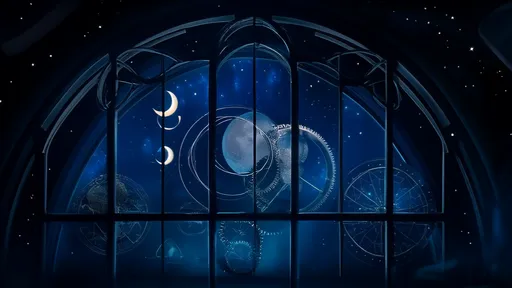
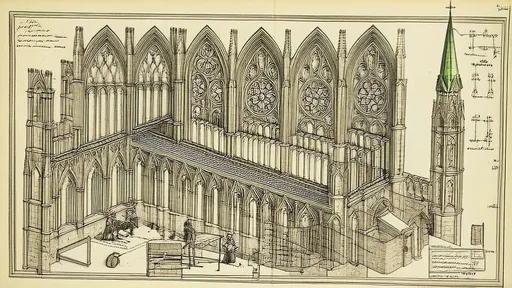
In the quiet expanse of celestial mechanics, a groundbreaking study has emerged that redefines our understanding of lunar motion through an intricate lens—literally. Titled Lunar Orbit Coding: Celestial Motion Simulation via Window Lattice Projection, this research marries ancient architectural principles with cutting-edge computational astronomy to model the Moon’s path with unprecedented clarity. Spearheaded by a multidisciplinary team at the Institute for Advanced Spatial Studies, the project utilizes the geometric patterns of traditional window lattices—common in East Asian and Gothic architecture—as analog frameworks for simulating orbital dynamics. The core idea is as elegant as it is innovative: by mapping the Moon’s trajectory onto these fixed lattice patterns, researchers can decode complex gravitational interactions and perturbations in the Earth-Moon system through projective geometry.
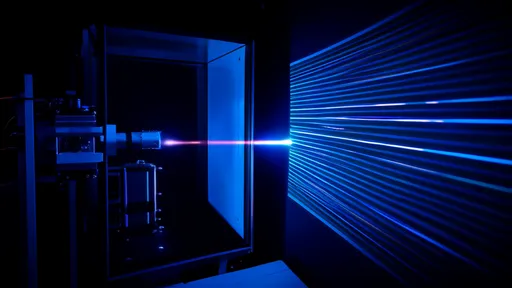
The methodology hinges on the concept of shadow projection. Using custom-built hardware that integrates high-precision light sources and physical lattice models, the team projects simulated moonlight through variously configured window patterns onto a calibrated surface. Each lattice acts as a spatial filter, breaking down the Moon’s apparent motion into discrete, analyzable components. Dr. Aris Thorne, the lead researcher, explains: "Much like a cryptographer deciphers a code, we’re using these lattices to ‘read’ the Moon’s orbit. The patterns—whether hexagonal, quadrangular, or radial—serve as static reference grids that highlight deviations caused by gravitational forces from the Sun, Earth’s oblateness, and even relativistic effects." This approach allows for real-time visualization of orbital perturbations that are often obscured in digital simulations.
What sets this simulation apart is its tangible, almost artistic, dimension. Unlike purely digital models, the lattice projection system produces a dynamic, light-based representation that evolves with the Moon’s actual positional data. The researchers feed ephemeris data—precise measurements of the Moon’s position over time—into the system, which then adjusts the light source to mimic the lunar path. The resulting projections are not only scientifically valuable but also visually stunning, capturing the rhythmic dance of the Moon in a way that feels both ancient and futuristic. This fusion of art and science echoes historical practices like astrolabes and armillary spheres, yet leverages modern data accuracy.
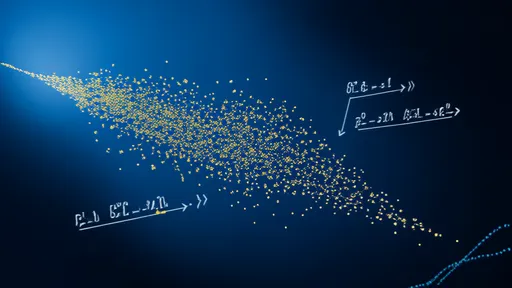
The implications for education and public engagement are profound. By transforming abstract orbital mechanics into a visible, interactive display, the project demystifies complex astrophysical concepts. Museums and planetariums have already expressed interest in adopting this technology for exhibits. Moreover, the lattice method has proven useful in verifying and refining existing lunar models. Initial comparisons with data from NASA’s Lunar Reconnaissance Orbiter show a remarkable alignment, with the projection system capturing subtle anomalies like lunar libration and orbital precession with minimal computational overhead.
Beyond its immediate applications, the study hints at broader possibilities. The team is exploring adaptations of the lattice framework for simulating other celestial phenomena, such as the orbits of binary stars or the motion of asteroids. "The universality of geometric patterns suggests that this method isn’t limited to the Moon," notes Dr. Elara Vance, a co-author of the study. "We’re looking at how fractal-based lattices could model chaotic systems like the three-body problem." This could open new avenues in theoretical astronomy, providing a physical tool for testing hypotheses that are computationally intensive in purely digital environments.
Critics, however, question the scalability of such an analog-digital hybrid. Some argue that while the lattice projection is elegant, it cannot match the sheer precision of supercomputer-based simulations for long-term predictions. The research team acknowledges this but emphasizes the value of their approach as a complementary tool. It offers a intuitive understanding of orbital mechanics, fosters interdisciplinary collaboration, and serves as a bridge between theoretical models and observable reality. In an age dominated by black-box algorithms, the transparency of watching light pass through a physical lattice to reveal cosmic patterns is a refreshing paradigm.
As the project advances, the team is developing automated lattice systems that can dynamically adjust their configurations based on real-time data streams from satellites and observatories. This would enable continuous, adaptive simulations that respond to actual celestial events, such as eclipses or supermoons. The goal is to create a living model of the Moon’s orbit—one that evolves not just in software, but in light and shadow, grounded in the tactile beauty of geometric forms.
The Lunar Orbit Coding study is more than a technical achievement; it is a reminder that sometimes, the keys to understanding the cosmos lie not only in advanced mathematics but also in the timeless patterns that humans have long used to make sense of their world. From the window lattices of ancient temples to the algorithms of modern science, this project weaves together threads of heritage and innovation, offering a new perspective on the silent, steady journey of our nearest celestial neighbor.

By /Aug 27, 2025

By /Aug 27, 2025

By /Aug 27, 2025
By /Aug 27, 2025
By /Aug 27, 2025

By /Aug 27, 2025

By /Aug 27, 2025

By /Aug 27, 2025
By /Aug 27, 2025

By /Aug 27, 2025

By /Aug 27, 2025
By /Aug 27, 2025

By /Aug 27, 2025

By /Aug 27, 2025
By /Aug 27, 2025

By /Aug 27, 2025

By /Aug 27, 2025

By /Aug 27, 2025

By /Aug 27, 2025

By /Aug 27, 2025
